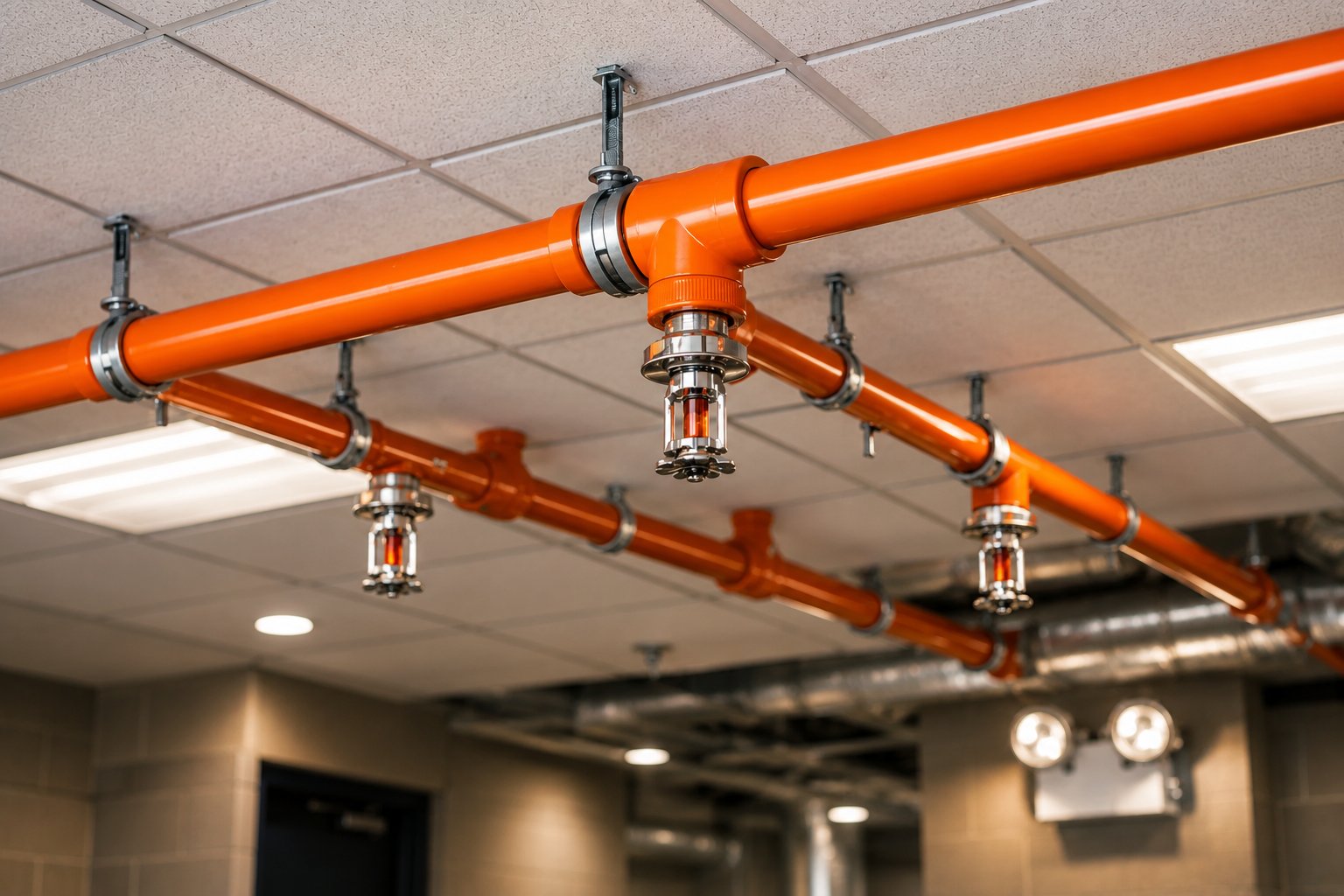
Orange CPVC fire sprinkler pipework — lightweight, fast to install, but vulnerable to chemical contamination from adjacent materials.
Silicone firesleeve creates a chemically inert barrier around CPVC sprinkler pipework — preventing ESC, plasticization and system failure.
CPVC pipework is now widely used in residential and commercial sprinkler systems throughout the UK, Europe and North America — and for good reason. It is lightweight, corrosion-resistant, cost-effective and fast to install. But CPVC has a critical vulnerability: chemical incompatibility.
When CPVC comes into contact with incompatible materials — certain fire-stopping sealants, electrical cable insulation, rubber pipe clips, spray foam, cable ties, oils and greases — it can suffer environmental stress cracking (ESC) or plasticization. Pipes become brittle or soft, fail under pressure, and the sprinkler system shuts down. The building is left unprotected. Forensic investigators at Hawkins have reported a significant rise in such failures, and CROSS Safety Report 1228 (2024) has flagged the issue as a growing concern across the UK construction industry.
The solution is a chemically inert physical barrier between the CPVC pipe and anything that could contaminate it. That is exactly what S Riley Fabrications firesleeve provides.
Orange CPVC fire sprinkler pipework — lightweight, fast to install, but vulnerable to chemical contamination from adjacent materials.
CPVC is an amorphous polymer that derives its strength from tightly interlocked molecular chains. When semi-volatile organic compounds — esters, plasticizers, hydrocarbons — migrate into the pipe wall, they disrupt those chains. The pipe softens (plasticization), swells and ultimately ruptures under water pressure. Alternatively, when stressed CPVC is exposed to these chemicals, it can crack suddenly with no visible warning (environmental stress cracking, or ESC).
Forensic analysis by Hawkins (2020, 2024) and CROSS Safety Report 1228 both confirm that the most common source of contamination is adjacent materials in contact with the pipe — including fire-stopping sealants, electrical cable insulation containing plasticizers, rubber hangers, cable ties and spray foam insulation.
S Riley Fabrications silicone firesleeve contains no plasticizers, no esters and no hydrocarbon-based compounds. Silicone rubber is chemically stable and does not off-gas or migrate compounds into adjacent materials. Wrapped around CPVC pipework, it creates a completely inert physical barrier — separating the pipe from anything incompatible in the surrounding service run.
No plasticizers · Chemically inert silicone · Tested by Spears FlameGuard · Made in BritainElectrical cable insulation — particularly PVC-insulated cables — contains plasticizers that can migrate into CPVC pipe on contact. Where sprinkler mains run alongside cable trays or bundled wiring, firesleeve wrapped around the CPVC pipe creates a silicone barrier that prevents any chemical transfer.
This is one of the most commonly overlooked contamination routes identified in forensic investigations and the CROSS Safety Report 1228 (2024).
Where CPVC sprinkler pipes pass through fire-rated walls or floors, the penetration is typically sealed with fire-stopping compound. Many fire-stopping products contain esters and organic compounds that are chemically incompatible with CPVC — causing ESC or plasticization at the point of contact.
Wrapping the CPVC pipe with firesleeve before applying any sealant creates a non-reactive surface, isolating the pipe wall from the compound entirely.
Rubber or foam-lined pipe clips and hangers can contain plasticizers that migrate into CPVC over time, softening the pipe wall at the support point. Under internal water pressure, these softened areas are susceptible to bulging and rupture.
Sleeving CPVC in firesleeve under clips and hangers prevents direct contact and eliminates this contamination pathway entirely.
Polyurethane spray foam (SPF) is commonly used in roofspaces, cavity walls and service ducts. Most SPF formulations contain esters and amine catalysts — highly incompatible with CPVC. Where sprinkler pipes run through foam-filled voids, contamination is almost inevitable without a barrier layer.
Firesleeve provides that barrier: chemically inert, continuous, and robust enough to resist the expansion pressure of curing foam.
Where CPVC systems have been installed with incompatible materials already in contact, full replacement is expensive and disruptive. Our Hook & Loop Retrofit Firesleeve can be installed over existing pipework in service — without draining the system or disconnecting joints.
This is particularly valuable for occupied buildings — hotels, residential blocks, schools — where system downtime must be minimised.
CROSS Safety Report 1228 specifically identifies crowded service penetrations — where pipes, cables and other services share a tight slot through a wall — as a high-risk contamination zone. In these areas, physical separation between CPVC and adjacent materials is often impossible without a wrapping solution.
Firesleeve is the thinnest practical barrier: 4mm wall thickness allows it to fit into congested routes where rigid separation sleeves cannot.
These are real-world incidents documented by independent forensic investigators and industry safety bodies — not hypothetical risks.
A large residential construction project in Ireland used CPVC sprinkler pipework throughout. Where pipes passed through fire-rated walls, a fire-stopping sealant stated to be compatible with CPVC was applied. Several years post-installation, pipes in contact with the sealant were found to be cracking and leaking.
Forensic analysis using SEM/EDS and FTIR revealed chemical migration between the sealant and the pipe — the chlorine concentration in the pipe wall changed measurably closer to the sealant. The sealant had been specified as compatible, yet caused failure. Source: Corcoran Consulting & Forensic Engineering, 2026.
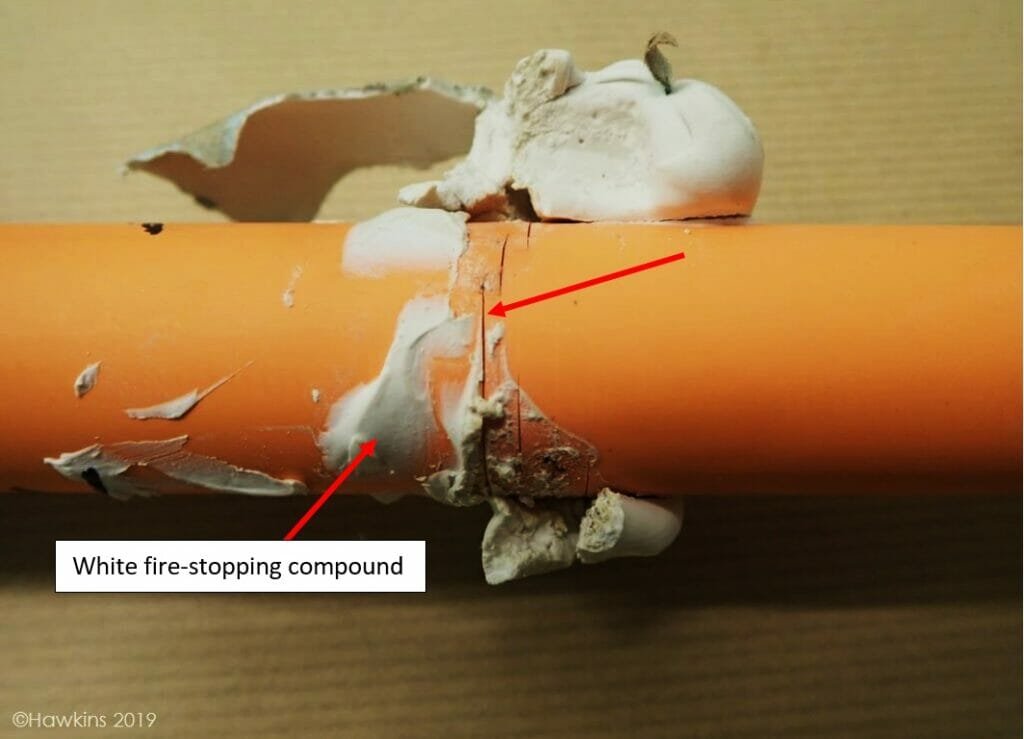
© Hawkins 2019 — CPVC pipe failure caused by incompatible fire-stopping sealant. Cracking visible at the point of contact.
Hawkins forensic investigators have been increasingly instructed to investigate water escapes from CPVC pipework. FTIR analysis of failed pipes has consistently identified ester contamination — either from fire-stopping compounds, insulation materials or construction products in contact with the pipe.
Some pipes exhibited softening and rupture (plasticization); others cracked with no visible warning (ESC). The same ester compound caused different failure modes depending on the pipe's compound formulation. Source: Hawkins Forensic Investigation, 2020 & 2024.
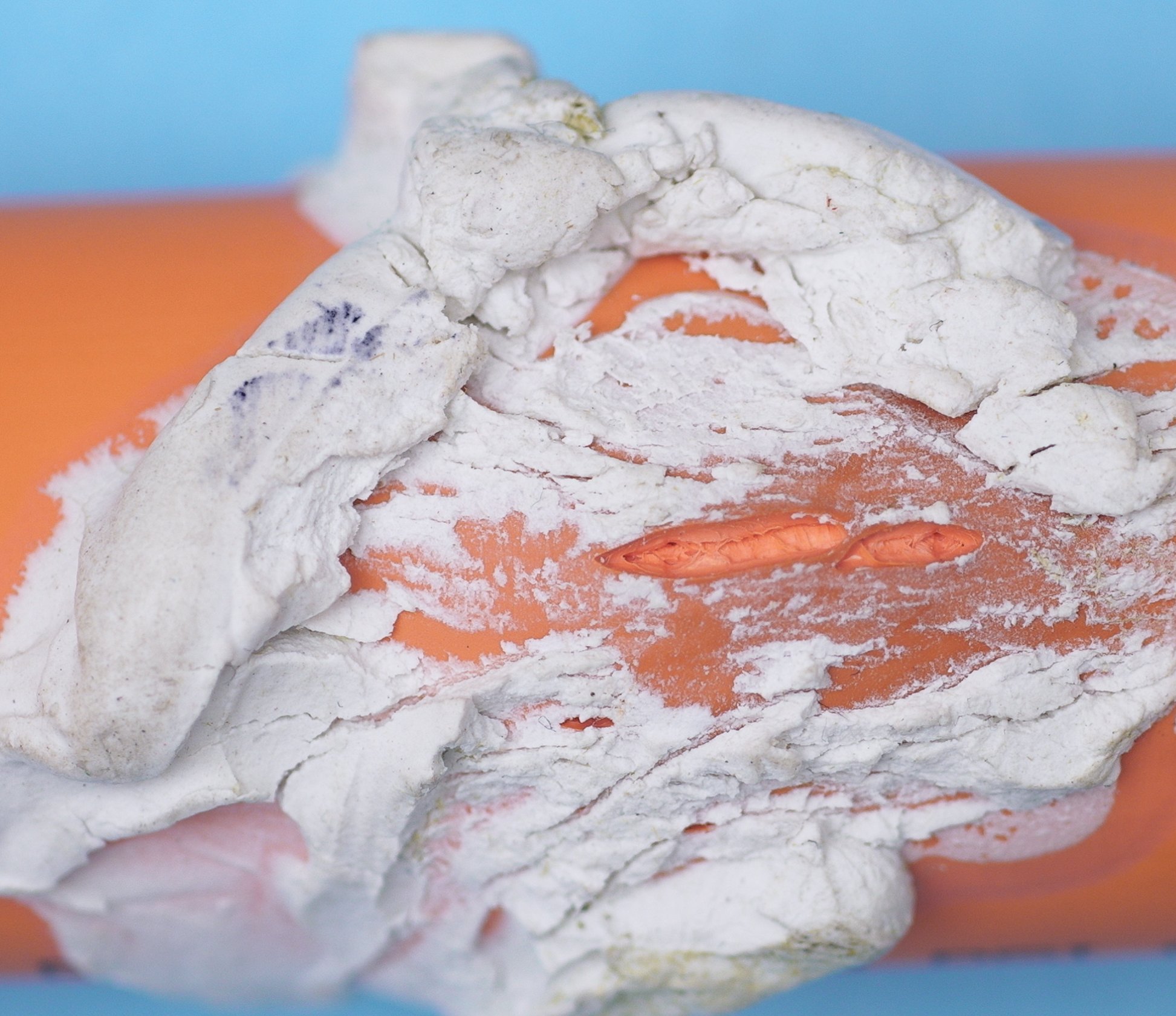
Forensic evidence of CPVC plasticization — the pipe wall has been chemically softened by ester compounds migrating from adjacent materials. No visible warning before rupture.
In February 2024, CROSS (Collaborative Reporting for Safer Structures UK) published Safety Report 1228 following a reporter's submission highlighting a growing wave of CPVC sprinkler failures caused by incompatible sealants. The reporter described failures in many premises, with sprinkler circuits taken offline for days or months during investigation and repair — leaving buildings unprotected.
The CROSS Expert Panel noted the issue extends beyond sealants to include electrical cables, plastic cable ties, insulation sleeves, pipe rings, cutting oils, paints and hand barrier creams. Source: CROSS Safety Report 1228, 20 February 2024.
IPS Flow Systems, the UK distributor of Spears FlameGuard CPVC sprinkler systems, actively recommends and distributes S Riley Fabrications firesleeve as a protective solution for CPVC pipework. Their fire protection brochure and product documentation reference firesleeve specifically — acknowledging it as an appropriate barrier where CPVC runs adjacent to potentially incompatible materials.
S Riley Fabrications firesleeve has been tested by Spears Manufacturing for compatibility with their FlameGuard CPVC fire sprinkler products — the leading CPVC sprinkler pipe system in the UK and USA. Source: IPS Flow Systems, ipsflowsystems.com.
Download the full PDF specifications — chemically inert silicone, no plasticizers, made in Britain.
IPS Flow Systems — UK distributor of Spears FlameGuard CPVC sprinkler systems — recommends and distributes S Riley Fabrications firesleeve as a protective solution for CPVC installations. Our firesleeve has been tested by Spears Manufacturing for compatibility with FlameGuard CPVC fire sprinkler products.
Standard Firesleeve is available from 4mm to 203mm internal diameter — covering the full range of domestic and commercial sprinkler pipe sizes. For occupied buildings where systems cannot be drained, our Hook & Loop Retrofit Firesleeve installs over existing pipework in service, without disconnection.
Technical documentation, compatibility evidence and pricing are available on request.
Tell us the pipe sizes, the installation type and the materials you're concerned about. We'll confirm the right product and come back with pricing and lead times.